AI Security Solution · LogOnAI
Intelligent security where AI analyzes threats and connects to response
Security threats are becoming increasingly automated and sophisticated. Simple rule-based detection alone makes it hard to respond quickly to diverse attack patterns and complex threat situations.
LogOnAI is an AI-based security solution that uses AI to analyze system logs, identify security threats, and support situation-appropriate response.
It connects multiple stages of security operations — from log collection and analysis to threat judgment, response suggestions, and active response within allowed scopes.
Also, no two companies have the same system environment and security policy. Beyond adopting the LogOnAI solution, we provide existing infrastructure integration, detection rule customization, AI model configuration, and security consulting to build an AI security system that fits your environment.
Key Services
1. What is LogOnAI?
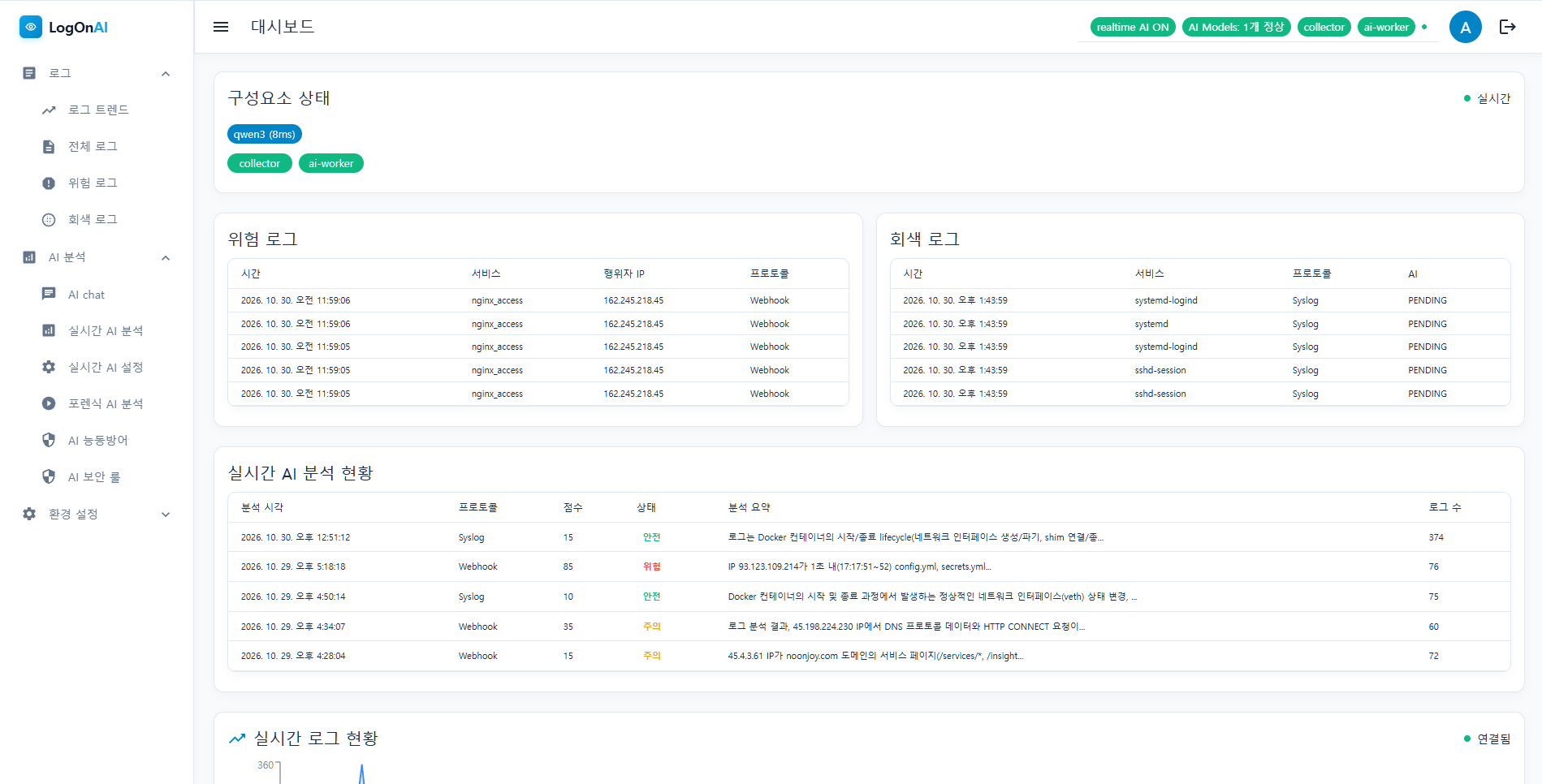
LogOnAI is a solution that collects logs from various systems and combines rule-based filtering with AI analysis to detect security threats and support response.
Where traditional security systems operate around pre-defined rules and known patterns, LogOnAI combines this approach with AI’s context understanding and analysis capabilities.
It is designed to go beyond checking a single log entry, comprehensively analyzing the frequency and temporal flow of multiple events, related IPs, and request patterns to identify potential threats.
For example, it can analyze situations where a web server is repeatedly accessed at abnormal paths in a short time, sensitive configuration files are probed, or requests different from normal service use occur consecutively.
AI presents analysis results and response plans, and can be configured to notify administrators or execute approved response procedures according to operation policy.
LogOnAI’s goal is to go beyond using AI as a simple analysis tool, to practically support security owners’ judgment and response work.
2. Key Features
AI-Based Log Analysis
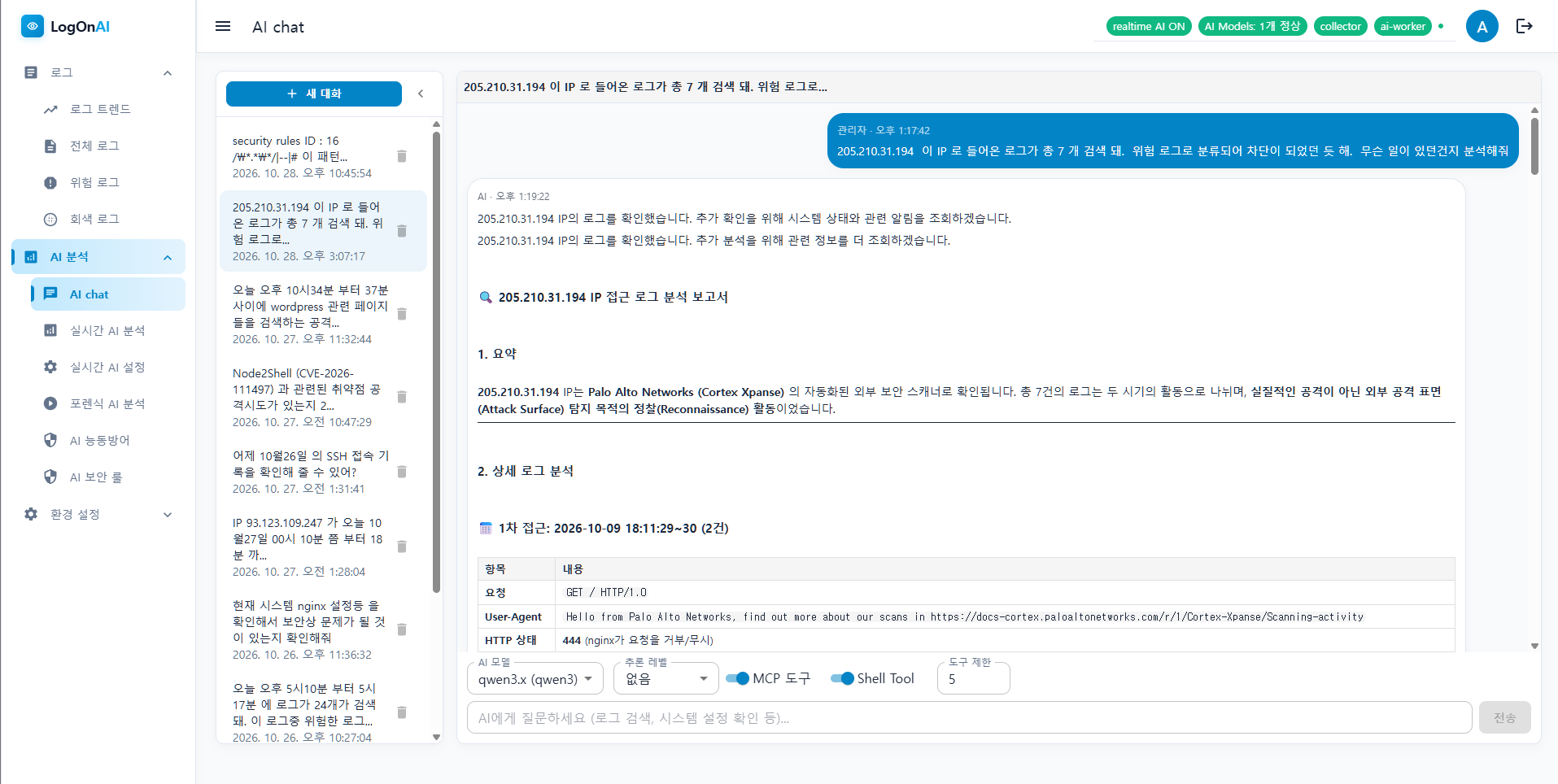
We support AI analyzing logs generated by systems and services to identify abnormal activity and potential security threats.
- Analysis of repetitive access & abnormal request patterns
- Security event analysis of web server & system logs
- Temporal & content correlation analysis across logs
- Explanation of attack likelihood and suspicious behavior
- Presentation of threat level & items needing further verification
Combining Rule-Based Filtering with AI Analysis
Analyzing all logs the same way can increase processing costs and operational burden. LogOnAI can build an efficient processing structure by combining rule-based filtering with AI analysis.
With this structure, repeatedly occurring events are handled by rules, while AI analysis resources are focused on events needing additional judgment about context and situation. Detection rules can be adjusted to fit the real system environment and operation policy, and you can also build a process to review and approve rules proposed by AI.
Threat Response Support & Active Response
As important as detecting threats is appropriate response. LogOnAI suggests response plans based on analysis results and, depending on system configuration, can connect to actual response tasks within allowed scopes.
- Investigation support for suspicious IPs & request patterns
- Related log search & additional evidence collection
- Response plans by attack type
- Connection to administrator confirmation & approval procedures
- Executing blocking or response tasks per approved policy
- Response result logging & follow-up analysis
Actual response capabilities vary by operating system, integrated systems, and granted permissions and settings. Important system changes or blocking tasks are designed to be controlled through pre-defined policies and approval procedures.
AI Analysis Results & Reports
We provide analysis results in a form security owners can understand and use.
- Key content of detected events & suspicion basis
- Analysis of related logs & timeframes
- Judgment on attack likelihood & impact scope
- Recommended response plans
- Records of response process & handling results
Report format and analysis items can be configured to fit your operation environment and reporting structure.
3. LogOnAI Customization for Your Environment
A security solution is not complete just by installing the product. It must be adjusted to the form of logs generated by real systems, service configuration, security policies, and existing operation methods to be properly used.
LogOnAI analyzes your environment and defines needed features and integration scope to support building a security system that can be practically operated.
Log Collection & System Integration
We review logs generated by your infrastructure and design collectable data and integration methods.
- Linux & Windows system logs
- Web server & application logs
- Syslog-based log collection
- Webhook & API-based event integration
- Connection with existing security systems & monitoring tools
- Collection & classification design for your own log formats
The actual support scope is reviewed according to each system’s log format and integration interface. Separate collection modules or conversion features can be developed when needed.
Detection Rules & Security Policy Customization
Each company has different normal usage patterns and events that should be judged as risks. Rather than applying generic rules as-is, it’s important to build detection policies that fit the real operating environment.
- Defining normal/abnormal log criteria per service
- Analysis & improvement of existing White/Black rules
- Rule adjustment to reduce false positives & unnecessary alerts
- Reflecting your unique attack patterns & exception conditions
- Setting AI analysis targets & priorities
- Configuring response policies & administrator approval conditions
Our goal is not to simply increase rules, but to continuously improve by considering both detection effectiveness and operational burden.
AI Model & Analysis Method Configuration
The AI model used for security analysis can vary by system performance, data sensitivity, analysis difficulty, and cost.
- Reviewing commercial AI API & local AI model application
- AI model configuration by log type
- Separating roles of rule-based filtering & AI analysis
- Optimizing AI analysis prompts & output formats
- Model configuration considering processing performance & analysis quality
- Execution environment design per your data handling & network policies
When needed, we can also review a structure that operates AI models on your internal servers. When using external AI services, we verify the scope of transmitted data and security policies in advance.
Integration with Existing Systems
Beyond operating LogOnAI independently, we can also support methods that connect it with existing business and security systems.
- Integration with existing monitoring & control systems
- Connection with notification & work handling systems
- Internal API & database integration
- Expanding response result & history management features
- Developing administrator screens & reporting features per your workflows
Integration feasibility and development scope are decided after verifying existing system interfaces and security requirements.
4. AI Security Consulting
To use an AI security solution effectively, you must understand your current security environment and operation procedures before adopting the product.
Based on LogOnAI setup experience and AI technology, we analyze your security operation status and suggest applicable improvement directions.
Security Environment Diagnosis
We review your current system’s log collection status, key services, security policies, and operation procedures to identify areas needing improvement.
- Confirming key systems & log generation points
- Reviewing log collection & storage structure
- Analyzing existing detection rules & alert policies
- Reviewing recurring false positives & missed detections
- Reviewing areas where automatic response can be applied
- Selecting tasks to improve first
AI-Based Security System Design
We design how to apply AI to security work, aligned with your requirements and constraints.
- Defining AI analysis targets & scope
- Separating roles of rule-based detection & AI analysis
- Reviewing local AI & external AI service application
- Designing data access & execution permissions
- Designing administrator approval & exception handling procedures
- Establishing phased setup & expansion plans
Operation Enhancement & Continuous Improvement
Security systems must be improved after setup to match new services and attack methods.
- Analyzing detection results & false positive cases
- Improving detection rules & AI analysis methods
- Organizing response procedures & operation policies
- Reviewing additional log sources & service integration
- Checking analysis quality & system load
- Technical advisory for future feature expansion
The consulting scope can be discussed to fit your needs, from short-term diagnosis to setup projects and operation improvement support.
5. Use Scenarios
Web Server Attack Detection
Analyze abnormal URL access, sensitive file probing, and repetitive vulnerability attack attempts in web server logs. Judge attack likelihood by synthesizing related events, and suggest needed investigation and response plans.
Response to Repetitive Attack Attempts
When suspicious requests repeat from a specific IP, we support additional related log search and analysis of attack patterns and impact scope. Blocking tasks can be connected according to pre-defined policies and permissions.
Efficient Classification of Normal & Suspicious Logs
Classify general system events and known patterns rule-based, and use hard-to-judge events for AI analysis. This improves analysis resource utilization and separates events security owners must verify.
Customer-Specific Security Monitoring
Analyze log patterns that occur only in specific industries or business systems, and build detection rules and analysis procedures aligned with your service operation methods and security standards.
Security Operation Workflow Automation
Configure AI to search related logs, organize analysis results, and write reports. As needed, connect procedures such as administrator confirmation, response approval, and result logging to reduce repetitive security work.
6. Setup Methods
Various setup methods can be reviewed according to your infrastructure and security requirements.
Basic LogOnAI Setup
Apply basic log collection and analysis features, integrate your key systems, and start operation.
Environment-Tailored Setup
Adjust log formats, detection rules, AI analysis criteria, response policies, and reporting features to your requirements.
Local AI-Linked Setup
In environments that must limit external AI service use or need internal AI operation, design the integration structure between local models and security systems. Hardware and model selection are reviewed based on throughput and performance requirements.
Existing Security System Integration
Maximize use of currently operating systems while adding LogOnAI, or expand features step by step in connection with existing workflows.
Phased Enhancement
Start with log analysis and reporting, then sequentially introduce detection rule improvement, additional integration, approval-based response, and automation features based on operation results.
7. Safe AI Security Operation
When applying AI to security operations, execution permissions and control methods are as important as analysis capability.
Since AI’s judgment is not always accurate, a structure that verifies analysis results and controls real system changes is needed.
When setting up LogOnAI, the following safety mechanisms can be reviewed according to your requirements.
These control methods are designed to fit actual integration features and your operation policy. Even when expanding AI autonomy, we prioritize clearly defining permissions and execution scope.
8. Setup Process
Requirements & Environment Analysis
Confirm protected systems, log generation points, current security policies, and operational problems.
Setup Scope & Architecture Design
Define logs to collect, analysis targets, AI models, integrated systems, and response scope.
LogOnAI Installation & Integration
Install the solution according to the agreed scope and configure the log collection and analysis environment.
Customization & Validation
Adjust detection rules, AI analysis criteria, reports, and response policies, and validate operation using real logs.
Operation Application & Improvement
Review operation results and continuously improve by checking false positives, missed detections, and processing performance.
9. Frequently Asked Questions
LogOnAI is a fully AI-based solution. Unlike traditional pattern-based SIEM analysis, AI analyzes logs and judges threats while watching the overall flow of logs. AI also directly obtains some system permissions to formulate and apply its own defense plans. To prevent excessive AI permission abuse, administrators can adjust the scope AI explores and modifies.
AI-based security —
build it to fit your environment.
The same security configuration is not best for every company. Accurately understanding your current infrastructure and operating environment and properly connecting needed technology is important.
From LogOnAI solution adoption to customer-tailored development, local AI linkage, and security consulting — we design an AI security system that fits your real operating environment together.
- LogOnAI solution adoption inquiry
- Environment-tailored setup & integration consultation
- AI security diagnosis & consulting
- Local AI-based security environment setup